
Laptop Upgrade Guide
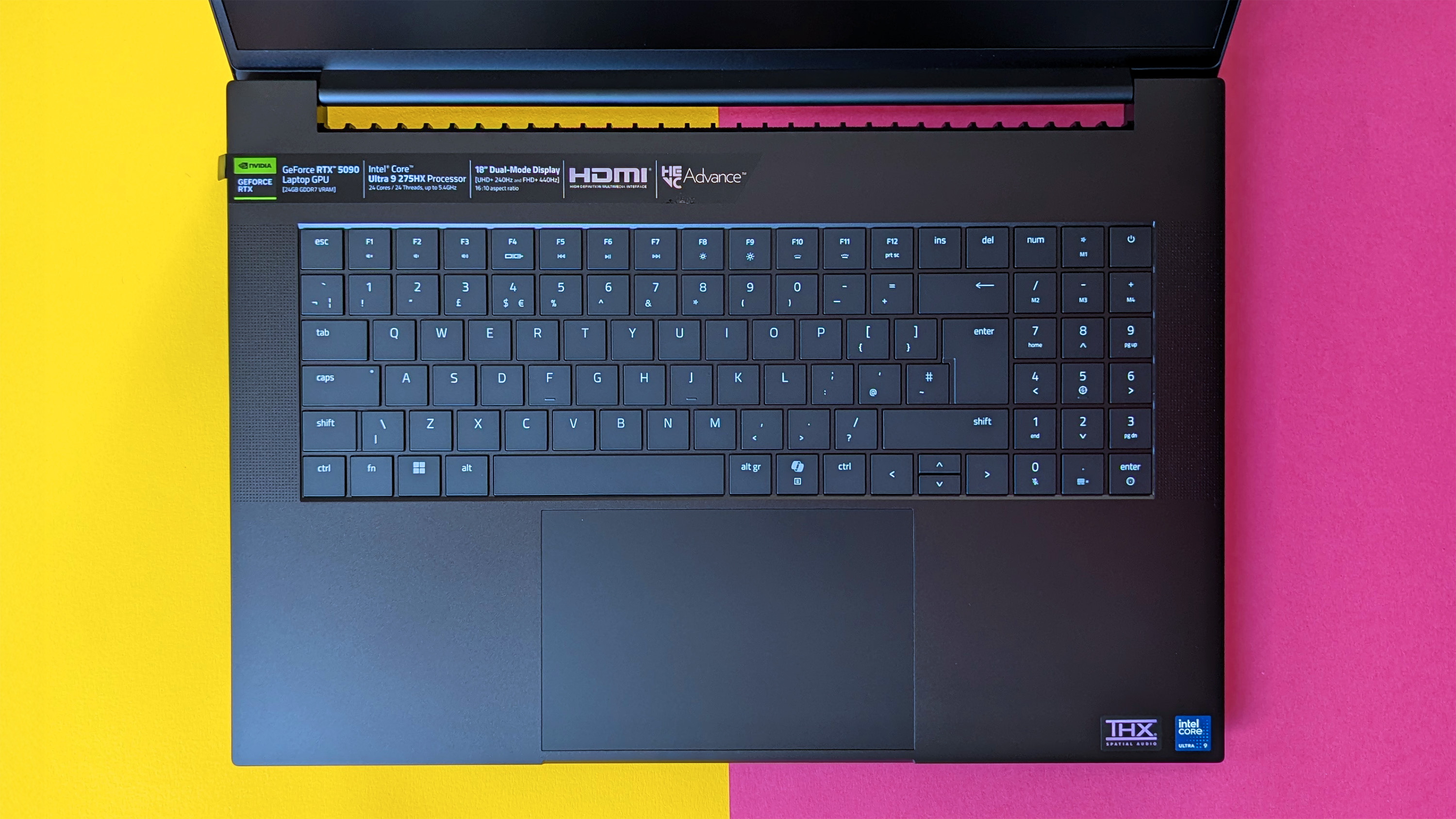
Razer Blade 18 (2025)
Model RZ09-0529 · Released 2025
- Max RAM
- 64 GB (DDR5)
- RAM Slots
- 2 SO-DIMM Slots
- Storage Slots
- 2 Slots (M.2 2280 · PCIe Gen 4 x4 NVMe)
Can you upgrade this laptop?
Memory on the Razer Blade 18 (2025) supports DDR5 upgrades across 2 SO-DIMM slots, up to a documented 64 GB ceiling.
Storage is documented with 2 physical storage slots (M.2 2280).
The internal battery (99 Wh) is documented as replaceable using matching service parts.
All findings below are cross-referenced against 1 cited manufacturer or technical document.
Standard configuration (RZ09-0529)
- Dual DDR5 SO-DIMM slots officially rated up to 64 GB total at up to 5600/6400 MT/s (varies by SKU).
- Dual M.2 2280 NVMe slots (PCIe Gen 4 / Gen 5 support depends on slot and SKU).
Memory
Upgradeable
Maximum 64 GB (32 GB/slot)
DDR5 · 5600 / 6400 MT/s
SO-DIMM
2 RAM slots
Storage
Upgradeable / replaceable
2 physical slots
- M.2 2280 · PCIe Gen 4 x4 NVMe · PCIe 4.0
- M.2 2280 · PCIe Gen 5 x4 NVMe · PCIe 5.0
Battery
Replaceable
99 Wh
Recommended Upgrade Parts
Shop compatible upgrades for Razer Blade 18 (2025)
Compare spec-matched RAM, M.2 NVMe SSDs, and precision repair tools on Amazon US.
Matched to DDR5 6400MHz SO-DIMM modules for this laptop's memory controller.
Disclosure: As an Amazon Associate, we earn from qualifying purchases at no extra cost to you.
Technical Upgrade Walkthrough
Razer Blade 18 (2025) Memory & Storage Architecture Guide
1. Memory Architecture & Dual-Channel Performance
The Razer Blade 18 (2025) features 2 user-accessible SO-DIMM slots rather than permanently soldered memory chips, making post-purchase RAM upgrades straightforward. Based on documented hardware specifications, the platform supports up to 64 GB using DDR5 modules rated up to 5600 / 6400 MT/s. Before purchasing replacement sticks, confirm how many slots are currently occupied in your factory configuration so you know whether you can simply add a second stick or must replace a matched kit.
Populating both channels with an identical pair of DDR5 SO-DIMM modules unlocks full dual-channel memory bandwidth on the Razer Blade 18 (2025). Dual-channel operation significantly improves data throughput for creative rendering, virtual machines, browser-heavy workflows, and integrated or hybrid graphics pipelines compared to single-channel layouts. Always match module speed and JEDEC timing profiles so the memory controller boots reliably at full rated frequency without manual voltage tuning.
2. M.2 NVMe Storage Expansion & Thermal Management
For storage expansion, the Razer Blade 18 (2025) provides 2 M.2 slots supporting M.2 2280 drives over PCIe 4.0 / PCIe 5.0. PCIe NVMe interfaces are backward- and forward-compatible across generations, so a Gen 4 SSD safely runs at Gen 3 speeds in a Gen 3 bay—though picking a drive matching your chassis length (M.2 2280) is strictly required for the mounting standoff to align.
High-throughput NVMe SSDs generate substantial heat during sustained file transfers or OS cloning. Check whether your Razer Blade 18 (2025) includes a factory thermal pad or thin copper heat spreader on the bottom cover or SSD bay, and avoid bulky aftermarket desktop heatsinks that prevent the slim laptop bottom panel from seating flush.
3. 5-Step Safe Hardware Installation Checklist
- 1
Shut Down & Disconnect Internal Power
Perform a full operating system shutdown instead of Sleep or Hibernate, unplug the AC adapter and USB-C peripherals, remove the bottom panel, and carefully disconnect the internal battery cable (or toggle the BIOS battery-disable option) before touching any internal components.
- 2
Observe ESD Protection & Grounding
Work on a clean, hard, non-carpeted desk surface, touch an unpainted grounded metal chassis screw before handling hardware, wear an anti-static strap if available, and hold memory or NVMe modules strictly by their non-conductive PCB edges.
- 3
Remove the Bottom Cover Safely
Use a precision screwdriver bit matching the exact Torx or Phillips chassis fasteners, map screws by length on a magnetic tray, and release perimeter plastic retention clips gently with a nylon pry tool without flexing the palmrest deck.
- 4
Insert Modules at a 45-Degree Angle
Align the gold-pin key notch with the motherboard socket, slide SO-DIMM sticks or M.2 NVMe drives firmly into place at roughly a 30 to 45 degree angle, then press down flat until side latches click or the M.2 retention screw seats cleanly.
- 5
Reconnect Battery & Allow BIOS Memory Training
Reattach the internal battery cable, verify any SSD thermal pad makes contact, secure the bottom cover, and power on; wait 30 to 90 seconds on the first boot while BIOS/UEFI completes memory training before expecting display output.
Sources
See an outdated specification or missing sub-model detail? Report a source-backed correction.
Frequently Asked Questions
What is the maximum RAM supported by Razer Blade 18 (2025)?
The Razer Blade 18 (2025) supports a documented maximum of 64 GB of DDR5 at 5600 / 6400 MT/s across 2 user-accessible SO-DIMM slots, making post-purchase memory expansion straightforward.
Does Razer Blade 18 (2025) have an extra M.2 SSD slot for storage upgrade?
Yes. The Razer Blade 18 (2025) features 2 M.2 slots supporting M.2 2280 form factors over PCIe 4.0 / PCIe 5.0, allowing you to add a second SSD without removing the factory OS drive.
What RAM speed and type does Razer Blade 18 (2025) use?
The Razer Blade 18 (2025) uses DDR5 running at 5600 / 6400 MT/s. Because it provides 2 SO-DIMM slots, installing a matched dual-channel pair boosts memory bandwidth and integrated graphics performance significantly.
Is it safe to upgrade the RAM and SSD on Razer Blade 18 (2025) yourself?
Yes, as long as you follow basic precautions: power the Razer Blade 18 (2025) completely off, unplug the AC charger, and disconnect the internal battery cable before touching the motherboard. Use a precision Torx/Phillips driver and a nylon spudger so bottom-cover plastic clips do not snap (and under the US Magnuson-Moss Warranty Act, upgrading compatible parts will not void Razer's base warranty unless physical damage occurs). Check compatible parts above in Recommended Upgrade Parts (#recommended-upgrades).
Related / Similar Laptop Upgrade Guides
Compare memory limits, SO-DIMM slots, and M.2 NVMe expansion across similar models.
Razer Blade 15 (2022) RAM & SSD Upgrade Guide
Up to 64 GB DDR5 · 2 M.2 Slots
Razer Blade 16 (2026) RAM & SSD Upgrade Guide
Soldered RAM · 2 M.2 Slots
Acer Nitro V 16 (2025) RAM & SSD Upgrade Guide
Up to 32 GB DDR5 · 2 M.2 Slots
Acer Predator Helios 18 (2025) RAM & SSD Upgrade Guide
Up to 192 GB DDR5 · 3 M.2 Slots
Acer Predator Helios Neo 16 (2025) RAM & SSD Upgrade Guide
Up to 64 GB DDR5 · 2 M.2 Slots
ASUS ROG Strix G16 (2025) RAM & SSD Upgrade Guide
Up to 64 GB DDR5 · 2 M.2 Slots
Check your upgrade compatibility
Want to check a specific RAM or SSD capacity for this model? Open the interactive checker with Razer Blade 18 (2025) pre-selected.
Open Laptop Upgrade Checker